
 YouTube
 Apple Podcasts
 Spotify
 Amazon Music
 "I Already Learned Those Lessons" — Renee
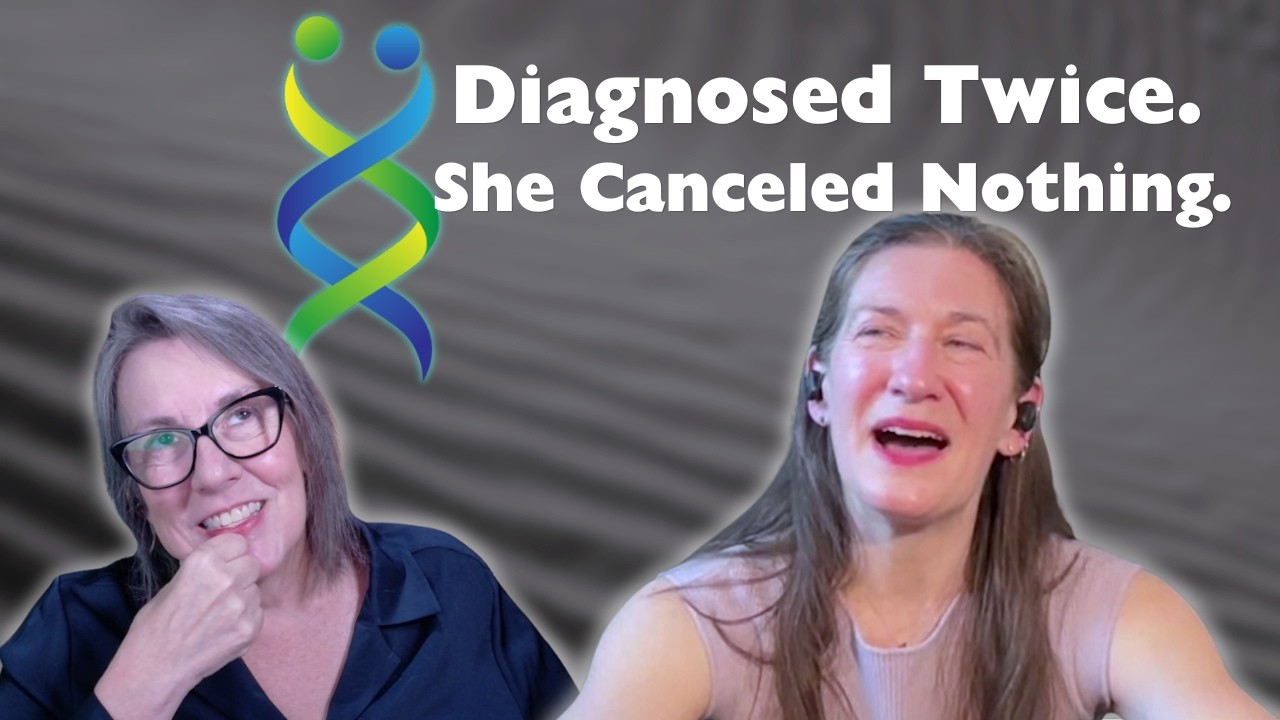
Renee was 50 when her first mammogram came back with a diagnosis: ductal carcinoma in situ (DCIS). She had a lumpectomy, radiation, and got on with her life. Two years later, the DCIS was back — same breast, more aggressive, with a feature called comedonecrosis that changed the calculus entirely.
This time, Renee came to her surgeon armed. Two years of research, Facebook groups, Reddit threads, and hard questions had prepared her to advocate for exactly what she wanted: a double mastectomy with flat closure, performed by both a cancer surgeon and a plastic surgeon, in a single surgery.
But the medical story is only half of what makes Renee's experience remarkable. A biomechanical engineer who has been doing aerial circus since her early 40s, Renee has turned cancer fear into something else entirely — performance art. Her "Maria Variations" series uses aerial acrobatics to move through the emotional stages of diagnosis and treatment, from purgatory to recovery.
In this episode, Renee talks about the decisions behind flat closure, navigating the Canadian healthcare system, the group therapy that changed how she approached her second diagnosis, and why she refused to cancel a single thing until she absolutely had to.
This is what cancer actually looks like — not the warrior, not the miracle. Just a person, figuring it out.
-- Go to ChangedByCancer.com for show notes and episode links
More info about Renee:
-- YouTube: @reneef1608
-- Vlog: https://youtube.com/playlistlist=PLObEuAagsg7_a2loLvCPBY6zHKXdw923t&si=HsMjsvrdslHq9h6A
-- Instagram: @cirqueduoldlady
-- Website: www.lucidengineering.ca
Resources mentioned:
-- Wellspring Cancer Support: wellspring.ca
-- Goldilocks mastectomy technique — ask your breast surgeon
Research articles referenced:
-- Hosaka N, et al., J Clin Pathol, 2006. https://pmc.ncbi.nlm.nih.gov/articles/PMC1860433/
-- Sobti N, et al., Sci Rep, 2020. https://pmc.ncbi.nlm.nih.gov/articles/PMC6981172/
-- Cevallos P, et al., Ann Transl Med, 2023. https://pmc.ncbi.nlm.nih.gov/articles/PMC10777214/
Changed By Cancer is hosted by Dr. Randi Paynter, a cancer epidemiologist. This podcast shares personal experiences and systemic issues in healthcare. It is not medical advice. Please consult your own medical team for health-related decisions.
Randi 00:00
Welcome to Changed By Cancer. I'm your host, Dr. Randi Paynter. If you're listening to us on your favorite audio platform today, you are hearing the soundtrack of a fully produced video episode. Today we are diving into the story of Renee, a brilliant biomechanical engineer from Toronto, who faced a recurrent breast cancer diagnosis. Because Renee's journey involves some incredible visual elements, including how she used aerial circus arts and clown performance to physically and emotionally navigate her diagnosis, I want to let you know that you can watch the full video version of this episode, complete with her performance footage over on our YouTube channel, or directly at ChangedByCancer.com. But whether you are watching or listening, her deep insights and incredible wit are universal. Let's jump in. a quick reminder. I'm a cancer epidemiologist, but I'm not your doctor or clinician. The conversations we have here are about personal experiences and systemic issues in healthcare. They're not medical advice. Please consult your own medical team for any health related decisions. So Renee is joining us today from Toronto, Ontario in Canada. She's going to talk to us about her experiences that came with a breast cancer diagnosis. So welcome Renee. I'm so glad that you decided to take time to share with us about your experiences. So, why don't we jump in with your breast cancer diagnosis?
Renee 01:59
My first diagnosis coincided with my very first mammogram. So, I guess we might as well start at the total beginning. So, my very first mammogram happened shortly after my 50th birthday. So, happy 50th birthday mammogram. They ran a test. They brought me back for more imaging. They brought me in for a biopsy. And then eventually by August of 2022 I was diagnosed with ductal carcinoma in situ. So it's early stage breast cancer but I was diagnosed with that. I received treatment. Standard treatment for DCIS at the small early stage is lumpectomy followed by five rounds of radiation. All of that happened here, here in Canada. The official diagnosis happened in August, late August, and then I had surgery in late November of 2022. Six weeks of recovery from the surgery and then five rounds of radiation. So, it was pretty much all done and dusted by, let me see, January, early yeah, early January of 2023. The first time I really just rolled with exactly what was being recommended. I'd certainly never been through this before and so when they recommended, you know, lumpectomy followed by radiation, I was like, Okay, that's what the doctors say I should do. That's what I'm going to do.
Randi 03:36
So you were told to get a lumpectomy. How did the surgery go?
Renee 03:40
I was a 34F. So I had some - I was not a small breasted person by any stretch of the imagination. And in my particular genetic line, that actually is small breasts. I have the, I had the, I had the smallest breasts of every woman in my family. We are a family with large tracts of land. Because when the lumpectomy happened, the results basically left me with breasts that were almost exactly the same as the ones that I had had before the cancer diagnosis. So I really did kind of get back to normal things, you know, I had a a small scar where they had gone in. They had actually used the exact same entry point as they had for the biopsy. So the scar really was like about that big. It was quite so that's, what, two centimeters, two centimeter scar. So it wasn't particularly big. It wasn't -- and they were my breasts and they still felt kind of the way that they always had. So it was kind of like it was what it was. I was thankful to have not had to go through a really big surgery.
Randi 04:59
So, it sounds like it was pretty straightforward as these things go. Have there been any updates since that point in time? What was it, January 2023?
Renee 05:11
Went on with my life. Had, you know, started having my yearly mammograms. So had one clear mammogram in 2024 and then my third mammogram ever, 2025. The DCIS was back. Same breast, more or less the same location that they had taken it out the first time. So that's when my breast surgeon and I had a much bigger conversation about what I wanted to do. For better or worse, I'd had two years to kind of think about it and do some research. And a lot of that information -- I'm going to, put out a big thank you to social media and people in the United States because honestly Facebook groups and Reddit groups in the cancer sphere have a huge amount of information out there and because our healthcare systems are similar, obviously not the same but similar, tend to follow very similar treatment plans, I was able to get a real sense of what my options were and what was likely to happen. So, I went into that that conversation with my breast surgeon the second time and I knew what kind of DCIS I had. It had a feature called comedonecrosis. I hope I'm saying that right. And so that increases the aggressiveness. So even though they're catching it at an early stage, it's showing signs that it was an aggressive, you know, a potentially aggressive form of cancer, the early stage version that's much more likely to eventually turn into a tumor. So you got to take it seriously. But because they caught it early stage again, I was offered a potential another lumpectomy. They don't do radiation more than once normally, so that was off the table. I knew at that point that catching cancer twice at early stage I was a really, really lucky person, deal of good fortune coming my way. I wanted to minimize my risks of having to try and catch it a third time. So at that point I opted for a double mastectomy and with a what's called a flat closure. So for anybody who's interested, it's called a Goldilocks to flat. So if you know what those words mean, you know what kind of reconstruction / non-reconstruction I have, which basically just means I don't have any breasts. It's pretty much flat now. And that was completed in mid December of 2025. And so now it's April the 10th of 2026. So, it's been about 4 months since that surgery. Happily they got it all, or at least they seem to have got it all. The margins weren't as good as they would have loved, but there's nothing else to take out anymore. I had already had radiation on one side, so that was not going to be an option for the future, especially since it was on my left side and my heart happens to be on that side as well. So they really don't like to radiate that area more than once. So I knew that was off the table. So both of those reasons pointed me toward, hey, you know what? A mastectomy is probably going to be a more thorough option. Personally, I wasn't comfortable with the idea being lopsided. So I wanted symmetry. Whatever I was going to end up having, I absolutely wanted it to be the same on both sides. And because I'm a biomechanical engineer, I have actually a shocking amount of information about how implants are designed. So, I've known for many decades that putting implants into soft tissues like the breasts is challenging. Like I already knew about capsular contraction and many of the different side effects. That these things sometimes leak, That different bodies react differently to different materials, and that that's unpredictable. These are all things that I've known simply due to my education as an engineer. Let's face it, you know, breast implants after cancer are decorative. They are there for psychological reasons. You don't get feeling in them. You don't have nipples, so you don't have sexual sensation. So all of those things, I understood what the limitations were going to be. So I knew that I didn't want the implants. I had the option of what's called flap surgery. Which is where they take a section of tissue from your body and actually make a breast mound, which would have been, pretty... something I definitely would have seriously considered except for two big problems with my own personal body. One is that that particular surgery has a really long recovery time. It's a pretty big surgery and I'm just a very physically active person and I wanted to get back to doing the silly circus stuff that I absolutely love and that keeps me mentally healthy. So, that was a priority for me. The other one was that I no longer had the stomach tissue, the abdominal tissue, that they would need for a deep flap surgery. So I didn't really qualify for the easier - it's not that easy - but the easier flap surgery. The other surgeries take like chunks of latissimus, not latissimus. Yeah, that you're basically, they can take a chunk of muscle, which I sure as heck did not want to happen because I like to do things that involve a lot of pull-ups and a lot of overhead strength. So, I didn't want that one. And then the final one is actually they take chunks from inside your thighs or from the buttocks like how, where, how do you lay and be comfortable? It sounded - so anyone who's had those surgeries, wow. You know the recovery from that, I did not have that kind of strength to do. So none of those options were for me. So that's why ultimately I basically concluded, okay, I would like to have a - technically I wanted something called a Goldilocks surgery.
Randi 12:18
So, as I understand it, the Goldilocks technique is a breast reconstruction technique that allows retention of a small breast without using any sort of prosthetic implant. So, this is what you wanted?
Renee 12:38
Okay. Because the Goldilocks procedure is ideally suited for women with large pendulous breasts. So big saggy breasts, that is something I had. I was like, hey, I am a 34F, 53 years old at the time. These, those girls were definitely heading south. Gravity had been doing some work. So I had the pendulous breasts that they were absolutely probably looking for. I went to see my breast surgeon and I said, you know, do I qualify for this Goldilocks procedure? My initial, my cancer breast surgeon thought that I would qualify for that. Unfortunately or fortunately in the end I also wanted a plastic surgeon because I basically wanted whatever surgery I was getting to be a one and done if at all possible because I wanted to get back to my life and my ridiculous activities. So I wanted to get back to my life. So I was very insistent that I wanted my excellent cancer surgeon and a plastic surgeon to actually do the closure because a Goldilocks procedure actually is a new and fairly complicated one. You know, it needs to be done by somebody who has special training. So they, I consulted with the plastic surgeon. Even the plastic surgeon's fellow who kind of did my initial intake. I was like, I think, a Goldilocks procedure is what I would like for my reconstruction. The fellow was like, yeah, yeah, I think, I think you'd be a good candidate. And the plastic surgeon was like, nope, nope, it won't work. What she said actually was that I had dense breasts, so I actually didn't have a lot of fat in my breasts. There wouldn't be a lot of fat left over, and I had thin skin. I don't think of myself as a thin skinned person, but turns out, especially on the side that had had radiation, the side that had had radiation, the skin thins. It's physically thinner. So she was like, I can tuck that in and do a Goldilocks, but you're not going to have an actual breast mound. She was like, I'm sorry. You're just not, I can't make something out of nothing. I was like, Okay, well, I knew what my number two choice was. My number two choice was that I wanted that same scar pattern that comes from the Goldilocks procedure, but with a flat closure. She was like, Okay. And that's exactly what I got. The tricky bit was that because now officially I wasn't actually having a reconstruction. I wasn't getting implants. I wasn't having a flap surgery. I wasn't technically having a Goldilocks done. The Canadian health care system was like, Well, then why do you need a plastic surgeon? So there was an exceptionally long wait to get, first to get approval within our national health care system to have both a cancer surgeon and a plastic surgeon. So just getting the approval to have that surgery covered by the health care system took some time because it was an unusual situation and it took time for the wheels to grind. And then because these were two extremely excellent surgeons because you got to remember I'm in the biggest, I'm in the biggest city in Canada. I had two spectacular surgeons. It then took some time to actually get it scheduled, find a time where they could literally be in the same operating theater at the same time. And so because early stage, it was a long, long wait. We signed the surgery documentation in I'd say the end of July, beginning of August of 2025. And the actual surgery initially was supposed to happen in mid November, but then there was a scheduling problem with one of the I think actually a nurse that was supposed to be involved with it. So I don't think it was any of the surgeons, but for reasons that there, I don't fully understand, it got put off and so the actual surgery, so signed the, signed all the paperwork. So had the full diagnosis and signed the paperwork, agreed on what kind of surgery it was going to be beginning of August and had the surgery middle of December 2025. And I'm not going to lie because during the surgery they also did a, not a lumpectomy, they removed some lymph nodes. So they took out some lymph nodes on that side to see if it had spread and I mean it took another six weeks for that pathology to come back. So from the surgery, so from middle of December until like almost the end of January, I didn't even know if I was getting chemo or not, I didn't know if there'd been any spread. So in both those situations, like those timelines are outside of the recommended timelines for where I am. Those are, that's not what it's supposed to be. Those were some tense months.
Randi 18:55
So, it sounds like all of the waiting and the uncertainty took quite a bit of an emotional toll.
Renee 19:06
So, now we're back to you know waiting. So, that's kind of the cancer side of things. But, as we have discussed, you know, there's the whole psychological side of cancer. And having been through this what I tend to refer to as a carnival ride, having been on this carnival ride now for the second time, you know, when I found myself standing there and getting into the car and having the thing come down around me as we went, you know, knowing approximately what I was going to be in for from a treatment standpoint, I took a different approach this time because it was my second time going around. So I kind of looked back on things that I wish I'd done the first time and I made some changes and I approached it very differently the second time. So that's the part that really changed for me was that I took a very intentional approach as opposed to just reacting to the diagnosis the second time that happened, than when I found myself in it the first time. So, to sort of get back to what the differences were between my first cancer experience and my second cancer experience. The first time, like I said, my dad had cancer, but I didn't know very much about treatment or even sort of how the system worked. So, I basically I just canceled everything, you know. I was like I was terrified. It was like a bomb had gone off in my life. You know, there was a giant explosion and suddenly I knew I had all these doctor's appointments and all of these things to think about and these worries. So basically, I just jettisoned everything out of my life that wasn't important, everything that wasn't sort of critical to kind of functioning, thinking at the time that I needed all those resources to deal with this thing that was happening to me and to be available to go to appointments and do anything at a moment's notice. But when the second round came, so two years later, after I'd had time to fully recover from the lumpectomy and the radiation, I was basically sort of back to myself. I was feeling very much back to myself. And in those two years, to be really honest, I did some real sort of digging. You know, I'd been through a big thing. And I started asking myself, sort of like my life had been exploded. I was like, okay, well, what matters to me? What? So, I made some changes. I'd made some changes in those two years. You know, they were small changes, but I really did do things and I was told I was feeling really great about things. I had kind of gotten myself to a place I was feeling really good. And I mean, at this point, I'm in my early 50s. This is notoriously not a time when women are feeling great about themselves. But so when the second diagnosis came, that was a punch to the gut, you know? I'm not going to lie, that was that was a real punch to the gut. And I mean, my first reaction was to be so annoyed. I was like, No, nope, nope, nope, nope, nope, nope. I learned those lessons. I did the hard, screw you. I was so mad. I was so pissed off, which you know the, the emotions got to come out some way. So I kind of channeled that annoyance and I was like no, I've already learned my lessons. I learned my lessons. Screw you. So, I was like, okay, you know what? Stop. I took a breath. I was like, all right, what lessons did I learn? If I learned something from that first experience, what did I learn? Because it looks like I'm going to do this again. So, what do I want to do differently? And the really big one for me was I was like, well, you know what? I am not canceling my life until I have to cancel things. It's like I am going to keep making, keep doing my things. Anything that I am, that I want to do, I'm going to sign up and I'm going to try and do it. If I have to cancel, you know what, maybe I'll lose a deposit. Maybe I'll have to adjust or change, but I'm not canceling anything straight out. And so that was really important to me that I wasn't going to regret anything if it ended up, sort of no matter what ended up happening. So that was the big one during and also knew that there were going to be a lot of big feelings. So, I actually signed up for a therapy group that started the month after I was done my first round of radiation treatment. And it met once a week for I want to say an hour, maybe it was two hours. I don't exactly remember. It was a few years ago, but it was incredible. I'd never done therapy before, let alone group therapy, but just being in a space with other people who were going through cancer. Admittedly, I felt like a huge fraud because I only had surgery and at that time it was a lumpectomy. I'd only had surgery and radiation. These were people that were like, going through chemotherapy. You know, the big super traumatic cancer treatments and they welcomed me into that space and they were like, Yeah, no, don't worry. You're one of us. You might have, just because you got to be super lucky and, you know, get your cancer caught early, you still have cancer and you're still, you're still part of the club that nobody wants to join. So they were incredible people and spectacularly welcoming and just being in a space with them and being able to share sort of the feelings and the fears, and sort of process some of that was really, really useful. The second time I actually found a different organization called Wellspring. And Wellspring offers a larger suite of services all for free. And some of the things that they offer are, you know, group therapy. They have Zoom groups as well because they're actually Canada-wide. So they have art therapy and exercise therapy, yoga. They're much more holistic in their offerings to not just cancer patients. That's the other interesting thing about Wellspring is that they have services for people living with cancer, people who are undergoing cancer treatment, but also for caregivers and anybody else who has had their life touched by cancer. So they have resources for young people and for caregivers and for cancer patients. It's an incredible organization. I can't say enough good things about them.
Randi 27:04
So, why don't we circle back and talk a little bit about just who you are and what background you brought with you into this experience.
Renee 27:18
I work for myself. I have six employees that work for me. We all work from home and then go out onto manufacturing sites to do the work and we spend a lot of time writing reports. So that's my actual job. I live in Toronto, Ontario with my husband and my 16-year-old teenager and two very large dogs. I was pretty much in as good a position as a person could be. My husband has a PhD and works in a fancy research lab. Nice stable job, excellent healthcare benefits because even though we are in Canada, drugs and things outside of hospital and doctor's visits very often do need to be covered. So we had excellent healthcare coverage that way on top of the standard issue Ontario healthcare plan. So we had all of that. We have savings, we have a very solid financial footing. So we were really fortunate that way. So he had a solid job and I have a solid, I had, well, I still do, I have a solid well-established company. My company literally just celebrated 18 years of existence. We have a solid reputation. So, I had financially that ability to step back and kind of coast from a work standpoint. I had established clients that I had longtime relationships with who when they hear that I'm having a health issue are spectacularly understanding, especially when I have other members of my team that I can point them towards. So, from a financial standpoint, I was about as lucky and fortunate as a person can be. You know, I had a boss that just always understood if I needed to take a nap or a mental health day or just, go for a walk. She always had my back. I am in the largest city in Canada. So, and because my husband actually works downtown, we have a home that's actually positioned to make it fairly easy for me to get to the hospitals that are right in downtown Toronto. So, that was a big boon from an accessibility standpoint. It meant that when I needed to go to appointments, when I needed to have radiation, and surgery, I could literally get on a subway and be at the hospitals within 40 minutes pretty easily. So, that part is pretty great. Like so many people, I work from home. It did mean that when I had a health issue, even though I'm in Canada, I still had to worry about the fact that I couldn't take any sort of official paid medical leave that I own the company. So that's not an option to me under, even under my particular country's circumstances. So that wasn't an option. And so I did have to get back to work fairly soon after my surgeries or at least be able to work as much as practical. The other great thing though is that I have an amazing team. So my team was there and they were - it was always a bit of a balancing act, but I never had to push anything beyond what it needed to be.
Randi 31:26
You know, the US health care system and the Canadian health care system have their similarities and have their differences in terms of the payer model and private versus public. And so in the US, one of the challenges is for people that live in more rural regions of the country to be able to access health care and to be able to have a choice in providers. And so I'm really curious about people in Canada. I'm sure there are a lot of them that live more rurally. Do they, how does Canada work with access to providers in terms of this kind of US / Canada differences versus similarity comparison?
Renee 32:37
People who live outside of the large urban centers of Canada don't have the same easy access to the exceptionally high level treatment that I was able to obtain. They can still obtain - So that's the funny thing about our health care system. Everybody who is living in Ontario legally - so whether a person's an immigrant or indigenous - technically we all have access to the exact same system. So if I lived in one of the remote communities I would run into the exact same problems apart from decisions that might get made based on skin color and presentation and how well spoken a person is because we all know that that can affect how doctors interact and diagnose. So that part aside they would technically have access to the exact same thing. So an immigrant living here in Toronto, would should could have access to the exact same doctors, the exact same treatment that I had. It's more of a location issue for many of us here in Canada as opposed to, just because our more remote communities and our people who are in our more remote communities don't have access to the same treatment without coming into the big cities which is definitely a problem. I certainly know that simply getting to the, because Canada's a big country, there are certainly people in our remote communities, you have to, you might have to get on an airplane in order to go for radiation treatment or chemotherapy. So those types of things are going to disrupt your life.
Randi 34:31
So, this is a topic that we've talked about a bit, and this is actually what got me curious about your diagnosis in particular is your love for the silly circus stuff that you mentioned previously. So, I'd like to talk more about this with you and find out more about how you got into it and how it's influenced your journey with cancer.
Renee 35:08
I'm actually a very active person. I do a lot of - been doing aerial circus since my early 40s and I - this is a very important hobby to me and I like to perform. So I was like what I'm going to try and actually make something with this energy. I'm going to give these feelings and these fears and all this anxiety that I know that's coming while I wait for diagnosis and biopsies and pathologies and all of that. I'm going to try and channel it. I'm going to try and give it a place to go. And so for me, that was making weird performance art because that's what I like to do for fun. Circus art. Circus art is probably the easiest way that nobody else is going to understand outside of the funny world. But I mean, yeah, I'm a Canadian, so that means that I've been very familiar with Cirque du Soleil since the very beginning. So the Cirque du Soleil was formed in the late 80s back when I was in high school and I was a gymnast and a trampolinist in my late teens and into my 20s. So I was very familiar with Cirque du Soleil. It's the band that I knew was cool before it sold out and became like super cool. So, circus arts is something that I've always been familiar with and I did study theater in university and I was just a theater kid in high school. I just happened to be a theater kid with amazing math marks which is how I ended up eventually becoming an engineer. But that's like I said that's a whole other very very long and complicated story. But the circus art piece in my early 40s I started taking what are called aerial classes. I took lessons in aerial hoop and aerial silks primarily which are things that hang from the ceiling and you do acrobatics around them. This was a wonderful way to get fit and find an artistic outlet at a time in my life where I wanted to sort of express myself. My child was getting a little older. I was starting to sort of come back to my own self, I found this artistic outlet. I started making routines and doing student performances. And it was something that I'd already been doing it for a number of years before the diagnosis. So this was already kind of part of my life. Through the COVID years, I actually couldn't go to a studio. I couldn't do anything that was hanging from the ceiling because we were all in lockdown for a time. And so that's actually where I eventually started creating characters. I created a clown because I found myself doing acrobatics in whatever place I could. I actually started using a doorway - the doorway of this office that I'm actually sitting in right now. I created a clown character called Pomo because it connected with Pomo's D'oro technique. If you're familiar with the Pomodoro productivity technique, it's a - I do like a good pun. So Pomo's D'oro technique actually had an opportunity to grow right after the first cancer diagnosis. Well, the first cancer treatment. One of the things that I actually did, and right after radiation was finished was participate in a very unusual residency opportunity where basically I was given some time in a window of a condominium in downtown Toronto. So, I had this sort of storefront window space that I could go to and basically spend some time actually sort of dedicated to making an artistic clown acrobatic piece that I performed in this window. So I used my circus art the first time to sort of get back to myself. I wanted, I used it kind of very much like physical therapy. You know, I had finished radiation. Literally my last radiation and my first day of that residency actually were the same day. It was kind of a very wild experience. So they were very interconnected for me through the first cancer surgery and the recovery from that. I started making characters and doing performances. And a thing about clown is I've taken some workshops over the years and I've learned that clown is a wonderful tool that can be used to lean into fear and anxiety because the clown itself is a creature that's created to fail. They try really hard and then the worst thing happens. They fail at what they're doing very often and that's part of the performance. That's actually ultimately kind of a good thing. I started thinking of clowns as ways to channel anxiety and fear. So, I actually created one of my first - Pomo was my first sort of ground-based acrobatic piece. But then when I actually started doing routines in the air again, I did the same thing. I actually took that same clown idea and I was like, Okay, well, I was really scared the first time I was performing about not being strong enough. I was scared that my hands were going to be sweaty and that I was going to slip off the equipment. So, I was like, Well, what if I made the character in the routine scared? I was like, What if they're really anxious? What if they're scared? I was like, What if they need time to go chalk up and they're afraid. And the entire piece grew from that. It actually grew from the fear. I ended up making an aerial routine where through the aerial routine, the character starts off fearful and scared and then their confidence builds over the course of the routine and they end up having fun and they end up having a good time and surprising even themselves with what they can do. And so that was part of my recovery from the first cancer. And that's why when the second cancer diagnosis came, it was the immediate place that I went. I was like, Okay, I'm going to take this fear. I'm going to take this anxiety that I know is coming and I'm going to make something with it. I'm going to give it a place to go. I'm going to have a place to channel that energy. And that's where the purgatory piece came from. It was performed literally in this cube that I'm sitting in right now. Because yeah, I found that the cube is a space that I like to use. I can do different acrobatics around it. So it was something I knew I was going to have access to. And so I started making that piece to deal with the fear and the tension that I had surrounding the purgatory. I actually titled the first piece Ave Maria Variations. The first one was Purgatory because Ave Maria seemed like the perfect song because it is meant to be a battle hymn. In Ave Maria, it turns out that the singer is actually praying to the gods before her father goes into battle. If I'm understanding the song correctly, it's a prayer before someone goes into battle. So for cancer treatment, that seemed like the right thing. And now I've started actually making - It's a series now. At each stage of the cancer treatment, I've been getting ideas of different routine performances that I'd like to do. I've already created the second one that's actually called Recovery. That's the post treatment version of this piece. And I've got two more in my - knocking around in here that need to find some actual expression.
Randi 44:44
For people who are only listening and not viewing right now, we're watching some clips from Renee's Maria variations. So, I'm really curious about how cancer has impacted your relationships. You mentioned that you have a parent that went through cancer and that you're now a parent that has a child at home while you're going through cancer. And so can you just talk to us a bit about, kind of a compare-contrast between those situations and how does cancer work with your family?
Renee 45:43
I was the first woman in my family, my immediate family to be diagnosed with cancer, with breast cancer. My own father actually had non-Hodkin's lymphoma about 20 years previously. He was diagnosed at stage four. It was very advanced and thankfully he is still here. He is still with us. But it was really interesting because I really knew pretty much nothing about cancer despite the fact that my father had gone through some very serious cancer treatment several decades before because I was in my late 20s at the time. And I think is common with parents of their generation. They really kept it from me. They kept the difficulty from me. I believe that they saw it as not wanting to burden their children. I was a fairly young adult. I was just trying to figure out my first job and going back to school and all sorts of different things that were kind of happening around that time. So, they didn't share the hard part. You know, I only saw the brave, the brave cancer patient, which I think a lot of people are very familiar with that sort of imagery. You know, the cancer warrior is something that we all admire. With my child I tried to be very frank and very appropriate in how I shared information. I wanted to make sure that they didn't feel that any information was being held from them, but at the same time, I didn't want to scare them. That was true certainly both times. The first time they were - for some reason it feels like they were a lot younger. They were also, like we were just coming out of the whole COVID experience and lockdowns, so they had already been through quite a lot in the preceding years. So for better or worse, they kind of didn't really clock what was going on with me health-wise. They knew I had to have a surgery and, they knew that that happened, but they were mostly kind of focused on their own world. So that seemed to go pretty smoothly. And then it was the second time that they seemed almost kind of blase when I first told them. They were like, Oh, yeah, well, you know, you've done this before. Such a teenager reaction. We know how to do this. It'll be fine. Which was pretty much their exact positioning right up until the surgery. But oh my gosh, just about a week before the surgery, I think the reality of it actually did hit them and they had - we had a lot of heart-to-heart talks around that time because they were pretty, they got pretty freaked out, so I shared the information that I have. I've never said to anybody, oh, it's going to be fine. I can't. I'm never going to guarantee my child or anybody else that it's guaranteed to be 100% fine. This is how the world works. So I never told my child that things were going to be okay. I was always - everything comes with a caveat; it always comes with tolerance bars. I'm like, yeah, I am probably going to be A-OK. There is no reason to think that I'm not going to be. Here are the steps that I have taken in the event that something does go wrong because, believe it or not, it did take me until my second cancer diagnosis to write my will. That felt a little bit stupid. We had a lot of talks. And I've never guaranteed, because one of the things that I've certainly discovered - my own bugaboo with how people respond to cancer and talk about cancer - is that I do have some people in my life that are like, Oh, you're going to be fine. You're tough. You're going to be fine. You're gonna - I'm like, maybe it's the engineer in me, but I'm like, no, you don't know that. How -- how can you know that? I'm like, I don't know that. Nobody knows that. This is real life. You know, there are no 100% guarantees. We don't know that. And I'm okay with that. I'm okay with the uncertainty.
Randi 50:58
It also makes me wonder about the other relationships in your life and how they have been or how they've changed throughout your cancer journey and have there been any surprises with respect to support or expectations throughout this journey for you?
Renee 51:20
That was the thing that I found about the organizations was just having the opportunity to just talk with some people who you don't have to wear any sort of brave mask around. I like to think that I've been pretty open with my friends. I really have sort of taken on that clown philosophy of just lean into the fear. What's the worst that's going to happen. So I try to kind of channel those things by saying them out loud rather than pushing, squishing everything down. But there's just something really comforting about being in a room where other people are like, yeah, I really hate it when people tell me I'm going to be fine. The biggest surprise about this experience is how much - I'm trying to find the words. It's how much I'm not a superhero. Like everybody - because I had a similar experience when my kid was young there was a time when I was a single parent, so it was just me and a child under the age of two and that period of time was very challenging, it was. And during that, I actually had some people say to me, people who were parents be like, Oh, I don't know how you do it. I couldn't do that. And my reaction at the time was like, Well, it's not like I have a choice. What else am I going to do? I don't have a lot of choice in the matter. And cancer's been the same way. I get uncomfortable when people are like, Oh, you're so strong, and wow, I don't know that I could have done that. And I'm like, Well, I'm pretty confident that you could. Because the other options are pretty horrible. So you find the strength, you do what you got to do. And so I'm just really thankful that I found the strength in me. It's been tough and the part that surprises me is because I've been pretty open about it and talked to other people about it. And it's the entire reason why when you put out this podcast idea, I had my hand up. I was like, Okay. Because every time I've shared honestly what's going on, both the fear and just the experience itself, it has come back to me. Other people that that I know and, like yourself, people that I didn't even know that were out there, have come and said, you know what, you said something and it helped. And so I guess that's the part that surprised me. I'm like, because I'm going to admit, I made that Purgatory thing, that was - I made it to help me. I made it for very selfish reasons. I made it to help myself because it helped me get through a tough time. And so it's been really surprising just how much that has then come back, it's kind of fed itself and that's been so spectacularly special because every time I hear that anything that I put out there was at all helpful, I'm just like, Wow, wow. Everybody's experience is going to be unique, but they're all going to have things in common. And I certainly have found through especially those long days that I was waiting for treatment and recovering from surgery, listening to other people's stories and hearing people just share what it was like for them helped it feel a lot less lonely.
Randi 56:14
I can't think of a better note to end this on, Renee. Let's just stop right here. I appreciate the time and the care and the energy that you've taken in sharing your story, your experience with us. It's brought connection. It's reminded us that we're not alone in this journey. You can get show notes, links, and other information at the website which is ChangedByCancer.com. I encourage you to subscribe and to “like” on your socials and I appreciate you for listening. Thanks so much and we'll catch you on the next episode.