
 YouTube
 Apple Podcasts
 Spotify
 Amazon Music
 "Alice in Wonderland Meets Sci-Fi" (Deborah — Part 1)
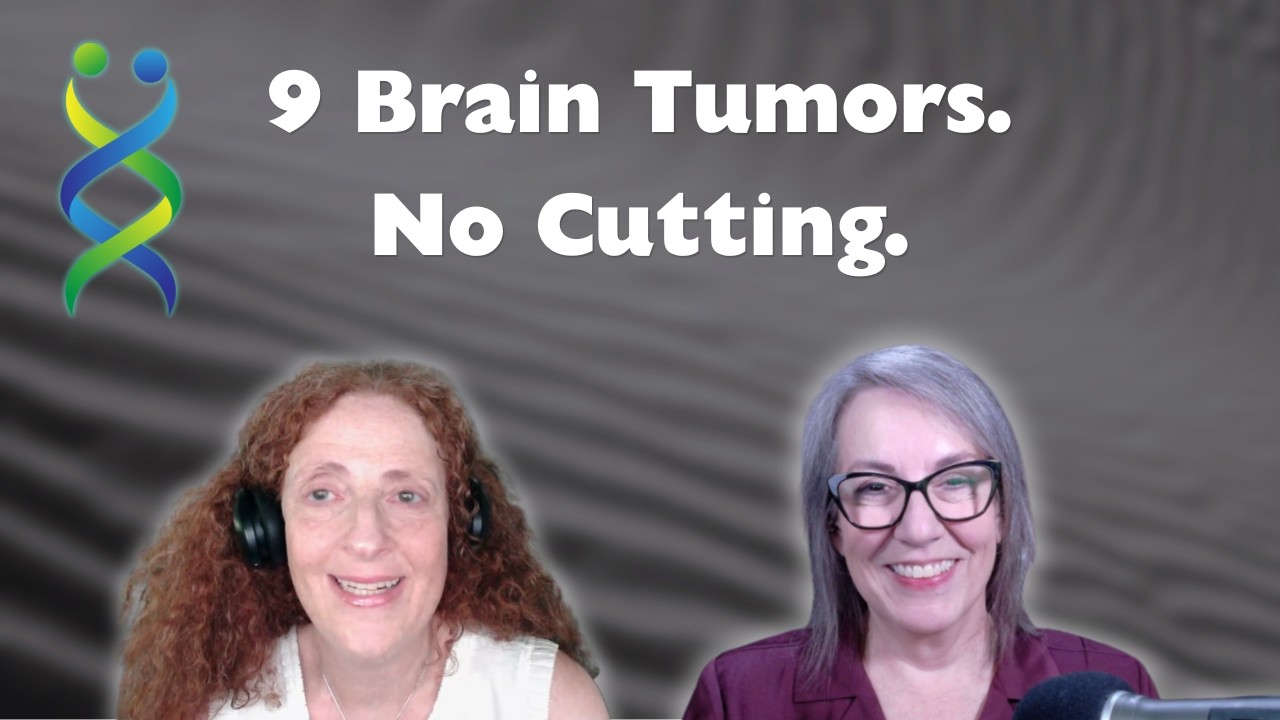
In April of 2013, Deborah was a busy mother of two young boys living in Brooklyn when a spot on her back came back positive for malignant melanoma. A sentinel lymph node biopsy was clear, but the pathology noted "melanoma in transit" — malignant cells already on their way to other parts of her body.
By September of 2014, the "bad stuff" had landed in her lungs. Her oncologist recommended a clinical trial combining a short course of radiation with a novel immunotherapy drug named Ipilimumab (Yervoy). But after just two infusions, Deborah developed severe, life-threatening colitis, forcing her team to halt the therapy entirely.
Then came the spring of 2015. Within a day of being told her lungs showed No Evidence of Disease, Deborah woke up and realized she couldn't find the words to speak. An emergency MRI revealed nine active brain tumors.
In this first part of a special two-part feature, host Dr. Randi Paynter sits down with Deborah to trace a medical timeline that broke the speed limit of standard textbook guidelines. It is a story of rapid clinical pivots, genomic sequencing, and a quiet, non-invasive laser surgery where physicians played "Space Invaders" with her tumors while Deborah listened to Satie.
We also bring back The Epi Edit, a recurring segment where Dr. Paynter steps outside the conversation to analyze the epidemiology and science behind the lived experience. In this episode, we explore the biology of Immune-Related Adverse Events (irAEs) and why severe immunotherapy toxicities are historically correlated with exceptionally strong tumor response rates.
In this episode, we discuss:
• The "In-Transit" Alert: Why a skin lesion that refuses to heal is a critical warning sign.
• The Trial Experience: Why Deborah immediately agreed to be a clinical "guinea pig".
• The Epi Edit: The clinical paradox of high-grade immunotherapy toxicities and long-term survival.
• Gamma Knife Surgery: Demystifying non-invasive laser-guided brain surgery.
• Steroid Mania: Navigating the sleepless, hyper-chatty reality of high-dose dexamethasone.
• I'll Live: How Deborah used writing as a cognitive lifeline and connected with a patient in Northern Ireland.
-- Go to ChangedByCancer.com for show notes, blog links, and resources
Research articles & links referenced:
• Deborah's Blog: I'll Live https://ill-live.com/
• Gamma Knife Overview: A patient-friendly guide explaining how focused radiation beams treat specific brain areas without incisions. https://www.mayoclinic.org/tests-procedures/brain-stereotactic-radiosurgery/about/pac-20384679
• Understanding Immunotherapy: What Is Immunotherapy? — An accessible overview of how these treatments utilize the body's own immune system to recognize and fight cancer cells. https://www.cancer.org/cancer/managing-cancer/treatment-types/immunotherapy.html
• Targeted Cancer Therapies: A clear explanation of how "precision medicine" drugs are engineered to block specific proteins that allow cancer cells to grow. https://www.cancer.gov/about-cancer/treatment/types/targeted-therapies
Changed By Cancer is hosted by Dr. Randi Paynter, a cancer epidemiologist. This podcast shares personal experiences and systemic issues in healthcare. It is not medical advice. Please consult your own medical team for health-related decisions.
My name is Dr. Randi Paynter. I'm a cancer epidemiologist, which means I spend my days looking at columns of numbers, trying to map out patterns of who gets sick, who survives, and why. I am trained to look at cancer through the objective lens of a dataset.
But every once in a while, I meet someone who speaks my exact language — the language of clinical evidence, tumor mutations, and survival curves — except they didn't learn it in a laboratory. They learned it because their life depended on it.
Her name is Deborah. She is a health sciences librarian, a mother, and an eleven-year outlier of metastatic melanoma. When we sat down to record, she described her path through the American medical system as a surreal trip where Alice in Wonderland meets sci-fi. It’s a story of lightning-fast clinical shifts, highly toxic drug combinations, and the raw creative survival of a woman who literally had to write her way through a brain full of tumors.
First, a standard disclaimer: I am a cancer epidemiologist, but I am not your doctor. The experiences shared here are personal and should not be taken as medical advice.
Randi:Let's go back to where Deborah's journey began in April of 2013.
Randi:Let's start off with, what brings you to this podcast?
Deborah:Well, I am a three-time cancer survivor. So in 2013, April of 2013, I was diagnosed with malignant melanoma. It was a patch of skin on my back, which I had actually had biopsied once before, and it was fine at that time. I'm really fair skinned. So going the dermatologist is something I need to do, but I probably wasn't going as frequently as I should have, given that I was a mom to very young kids at the time, and so that spot really didn't kind of heal up. And I learned later that that can also be a warning sign of melanoma, is skin that doesn't quite heal. So in April 2013, I had it biopsied again. And it was on my back right where, like your bra clasp hits. So I always thought, oh, it must be my bra or something. But yeah, that second time, it came back positive for melanoma.
Deborah:So I got the call from my dermatologist and he was recommending that I see… I lived in New York City at the time, so he was recommending that I go to a particular surgeon at the NYU Cancer Center. And so I did, and that began my cancer journey. So I had melanoma surgery in late April 2013. At the same time, they did a sentinel lymph node biopsy, and there was no lymph node involvement. But the pathology report said that there is evidence of melanoma in transit, which meant, cells on their way to do bad things. And so I was followed with scans, and I had a scan in August. Came back fine. I think I had one the following spring. I can't remember for sure. I was fine in September of 2014.
Deborah:I was sitting in my car in Brooklyn waiting for a street cleaning to be over so I could park it. And I got a call from my medical oncologist who said, we found the bad stuff in your lungs, and you need to come see me right away. I'm a very stubborn person. So for me, that meant wait until the street cleaning was over and my parking spot was legal, which was like another 40 minutes and then take the train into the city. And so I sat down with my oncologist. My husband was there, too. And, she said, your timing is excellent. Your timing is excellent because, five years ago, ten years ago, we wouldn't have had much to give you. But there's this thing called immunotherapy. It's been through trials. It's approved. And it works for melanoma. So we want to try that. And I was like, sign me up. And then she said, and also, we have a research study going on to see whether a short course of radiation to the lung is going to accelerate the work of the immunotherapy drug. And I said, sign me up. And I remember asking my doctor, why wouldn't a patient want to sign up for something like this? And this is where I first got the sense of how funny my oncologist was. So she put on an accent of a patient who had recently refused to join the study. And she said, I'm not your guinea pig. I was like, oh, okay. Well, I, I'm here to be a guinea pig. Let's do this. Let me sign up, see if this works. So it was a randomized study. So, I signed up, but I also had to get randomized into the group that was getting radiation — and I was.
Deborah:So that was the second part of my cancer journey. But there are many twists and turns. Immunotherapy — I got through two infusions. The drug was called Ipilimumab or the trade name is Yervoy. I always say that these names. Well, some of the drugs sound like Norse gods and some of them sound like soccer players from central America. Like, I don't know where they get the names. But the immunotherapy gave me colitis, and I got really, really sick, so they had to suspend the treatment. I had to get two infusions of Remicade, which is something that's given to patients with ulcerative colitis. And that was it for immunotherapy. And my doctor and my nurse practitioners urged me not to freak out that this hadn't worked. They said it could be that you're having a really strong immune response, and that could be positive news in terms of the tumor activity. So just, you know, don't freak out. And in the meantime, of course, there were so many other drugs under development and heading for trial. So it really seemed like a really auspicious time to get cancer if there ever is one, which there never is. But, it was a good moment. I had good insurance, and I lived in New York, which is one of the best medical cities to live in. So I had a scan, so all of my colitis and everything resolved in time for Thanksgiving 2014. I had my first really big meal on Thanksgiving. It was great.
Randi:I want to pause the conversation for a second to put some real context around what Deborah just described — I call this pause The Epi Edit. It's a short break where I step out of the conversation and into the data, the policy, or the clinical piece behind what you just heard. When we talk about immunotherapy, specifically checkpoint inhibitors like the ipilimumab or Yervoy Deborah was taking, we are looking at a paradigm shift in oncology. Traditional chemotherapy is a sledgehammer that poisons fast-dividing cells directly. Immunotherapy, however, works by unblocking the patient's own immune system, allowing it to recognize and actively hunt down cancer cells. But turning the immune system’s brakes completely off is an incredibly volatile game. When the immune system becomes hyper-activated, it can lose its ability to distinguish between a tumor cell and healthy normal tissue. What Deborah ran into — severe, acute colitis — is what we clinically categorize as an Immune-Related Adverse Event. Epidemiologic and clinical trial data show a profound paradox here: patients who experience severe, high-grade systemic toxicities from immunotherapy often display significantly higher objective tumor response rates and long-term progression-free survival. The toxic side effect is the biological receipt showing that the immune engine has successfully caught fire. Her nurse practitioners and doctors knew exactly what they were looking at when they told her not to freak out; that colitis was the physical evidence that her body was mounting an aggressive fight. But as you're about to hear, melanoma is uniquely fast and predatory.
Randi:After the colitis resolved, you had a brain MRI in January 2015 that showed absolutely nothing. Your brain was clear. What happened then in April 2015?
Deborah:So then my next scans were in April. So April, two years after my initial diagnosis and about six months after starting immunotherapy, I had a CT and went in to see my oncologist. I saw her in the hallway giving a high five to the nurse practitioner before they came in, and she said, your lungs are NED — no evidence of disease. Like what? That really seemed too good to be true. It was true. But also, for a few weeks before my scans, I’d been having kind of dull headache and been really, really, really tired. And for like a day before I went in for my scan results, I woke up that morning and I was having trouble finding words. I was working at the time. I'm a librarian. I had been out of work for a long time, and then I got a temporary job at a college library. So I was meeting with a student, I remember, and all of a sudden, I was trying to use sign language to talk to her, and, I don't know sign language. I was like, where are my words? This is really weird. So I thought it was just that I was nervous about getting my scan results. So the next day, same thing happened. You know, I went to get my scan results and I was so happy. And I mentioned like, yeah, I've been having some headaches, but like, they didn't, you know, they checked me out. They didn't really see anything. And then the next day it happened again. And so I called and they're like, get to the E.R., stat! And so I worked way uptown in Manhattan. And as I may have mentioned before, I’m a little stubborn. So stat for me meant sit through the rest of my staff meeting. Find a colleague to cover my consultations for the afternoon. Have lunch with my friend whose dad had just died. Then take the subway and the crosstown bus to the E.R. So go to the E.R. If you go to the E.R. hoping to get an MRI, you will wait many, many, many hours. Because a CT is a much quicker scan. They pop you in and out of the CT. But, an MRI can take half an hour or longer, and so they've got those machines scheduled. So after probably 8 or 9 hours waiting, I had my MRI and they found tumors in my brain. Initially, they said “several.” Later, much, much later, I found out it was like nine, which is more than several to me. But what was causing my difficulty finding words is that I had a three centimeter tumor on the part of the brain that controls language. So I spent the night in the hospital only one of two nights throughout this whole ordeal that I spent in the hospital. The other was when my lung collapsed when they did a lung biopsy. So I spent the night in the hospital. The neurologist kept waking me up every hour to ask me who the president was.
Deborah:And then the next morning, they sent me back to my oncologist. And she handed me a bottle of pills, which had belonged to another patient. Their name was ripped off, like, leftover… leftover medication. And she said, start taking these right away. I'm going to get you some steroids, too. Just start taking these, like, immediately. And I said, what is this? She said, it's targeted therapy. And because we genetically sequenced your tumor when we did the lung biopsy, we know that you have the BRAF mutation of melanoma. And this medication is a match for that. And it will penetrate the blood brain barrier and start taking it right away. So I did that. I was taking probably 100mg or more of dexamethasone every day. I was out of my mind. Very, very awake all the time. Alert. Couldn't stop talking. But feeling a lot better than I had been when I had colitis for sure. And I could definitely eat. But the craziest thing was that within days, like, probably within five days of starting the targeted therapy, I could already tell that my word finding issues were starting to abate. And that was wild. So, I was taking the targeted therapy for six weeks. At that point, I had another MRI and all of the tumors were shriveling.
Deborah:And so then it was time for me to have brain surgery. But again, like everything on this journey, I like to call my journey Alice in Wonderland meets sci-fi. Because, you know, my doctor handed me a bottle of pills and said, eat these, right? And then all of a sudden, I'm having brain surgery, but it's laser-guided. It's laser. It's non-invasive surgery. They don't cut, right? So, gamma knife surgery. The only part that was kind of not so fun is that there's a titanium frame that they kind of have to bolt to your head. So there are there's some, like, little screw marks in your forehead afterwards, but they do that so you don't move your head during the surgery. So they do an MRI directly before the procedure. And then they map out where they need to focus the gamma rays. So gamma radiation is like the weakest form of radiation. But the gamma knife machine focuses hundreds of beams of gamma radiation, only at the tissue that is affected — that has the lesions — so that it leaves the rest of your brain tissue fine. Which is key because there's so many things that could… so many deficits that could show up if you have brain surgery that is the other kind. So, they do the MRI, then they put you in this tube that is very similar to an MRI machine, except it's completely quiet. I was listening to, like, Erik Satie music from my phone during my surgery, it was that quiet. And my surgeon and the physicist are wearing suits and sitting in the next room, basically playing Space Invaders with my tumors, right? Just pew pew and, yeah, it was really exciting. I was just very geekily excited about this whole thing. It was just kind of amazing to me, that this might work. And as it turned out, it kind of did. So, I kept having MRIs. I don't remember how frequently the MRI, the brain MRIs were after the surgery. But I will also say that a few weeks after brain surgery, I was horseback riding in the Rocky Mountains with my family, and that was just nothing that I could have anticipated would be possible. So that was amazing. So that was 2015. November. I had another MRI of my brain. And this whole time, by the way, I'm continuing to have CT scans of my lungs. Nothing ever shows up on my lungs again. And in November, there was one spot on the MRI which showed bleeding. And so the disadvantage of an MRI is if there's bleeding, they can't see what's underneath the bleeding. And melanoma tumors bleed a lot. They bleed when they're forming. They bleed when they're being starved out. So my neurosurgeon had no way of really knowing what was there. And, you know, because this was still all kind of fairly new and because he is such a gamma knife proponent, he checked with his colleagues and all of his colleagues were telling him to cut rather than do gamma knife again. But he told me, you know, I really would like to try the gamma knife one more time and see how that goes. And I am so glad that he did that, because that was November 2015, and there has not been a single active tumor in my brain since then. So almost 11 years.
Randi:That last known melanoma issue was way back in November of 2015. That is a truly incredible response. But I remember in early chats that you discussed having a period of intense, hyper-chattiness. Was that a consequence of the brain tumors themselves, or was that a side effect of the high steroid doses?
Deborah:Yeah. So I was on these huge doses of dexamethasone when they found my brain tumors. When I had colitis, I was also on lots of steroids, but that was prednisone. And when I had colitis, I was miserable. I was starving. I was lying in bed in pain and like, daydreaming about, like one day being able to eat like, brussels sprouts again. And, but with dexamethasone, I had brain tumors. So, yeah, it was a little weird to have this language deficit. But, I was so excited about all of it. Like, I was really like... It was like they had given me the kool aid, the cancer kool aid. And I was like, yeah! And like, so we lived two blocks from my kid's school. And so I remember, I’d walk them to school in the morning and it would take me like 45 minutes to an hour to get back home because I would run into people on the street and just start talking. And I couldn't stop talking. And my mom remembers this and my husband remembers this. And like, if talking were it, that would have been fine. But I also just started coming up with like schemes. I am not a type A person. I am not a planner. I'm not a long range planner. That's actually been great in terms of dealing with cancer. But I just started coming up with like every half hour another completely insane scheme. I'm too embarrassed to even talk about them now. But like, one of them was going to require some serious like crowd funding for this particular trip I wanted us to… Yeah. Anyway, yeah. Luckily they started tapering my dose of dexamethasone because I couldn't sleep. I couldn't stop talking. And, yeah, I imagine I was a treat to live with.
Randi:Well, the world benefited because you were blogging through that entire chemical surge, and you still keep that blog up today.
Deborah:Oh, yeah. Yeah. So I started my blog in November of 2014. So I started my blog, interestingly, right at the point where the immunotherapy started making me sick. It was a really interesting time to choose to start. So like start at the worst possible moment of my journey so far. But I, so I had… I remember doing a lot of research. So I'm Jewish and that year I decided — Yom Kippur is a really important day for Jews, really important holiday. And we, every year we would spend it with my in-laws. And that year I was like, you know what? I'm not doing this this year. Like, not only am I not fasting, but I'm not going to go to services and I'm just going to stay home and think about this blog that I want to start. And I wound up on an online chat with a friends who had been through an MFA program, and she was really interested in what I wanted to do, and she gave me a whole long list of like, books that I should consider reading, which were like, you know, memoirs that were kind of health related and stuff. And I just walked over to the Brooklyn public library and like every single one of them was on the shelf. Checked them all out. Brought them — Yeah, it was a memorable day, and that was the day I decided, yeah, I'm going to start this blog and I need a name for it. And I chose a name that was really pretty audacious, because I called it “I’ll live.” I didn't know I was going to live, but I intended it as kind of, you know, I got cancer, but, yeah, I'll live — like, in that sense. And so it's called I’ll live. Cancer is hard, but not the way you think. And so that also, like, all these years later, I'm like, wow. Like, I really had no idea what I was starting there, but, yeah, it was… I just had this sense that my cancer wasn't going the way that other people expected cancer to go, right? I'm Jewish. What's the Jewish cancer that women get? Breast cancer. Wasn't getting that. I had melanoma. Wasn't having chemo, wasn't losing my hair. I mean, briefly had nausea when I had the colitis, but, like, didn't generally have nausea. So, you know, I needed to explain some stuff to people. Like, what is immunotherapy? What is targeted therapy? What is gamma knife surgery? What is all of this that is happening with you? Because I don't recognize this as cancer. So yeah, I started it and it really became a lifeline for me. I blogged through being sicker than sick with colitis. I blogged through starting a new job and then, like, a month and a half into it, having a brain full of tumors and quitting my job. And like, I blogged through my language deficits, which is really fascinating to go back and read those posts, which I have not edited, and to see the kinds of language, like the kinds of word substitutions and inventions of words I was doing. It's really fascinating to me now. I mean, I'm so lucky that I can look back and be like, whoa. So, you know, I keep it up to this day. Obviously I don't post as much as I used to because thank God I'm not on steroids anymore. But also, you know, it's a cancer blog and I don't necessarily want to transition it to some other kind of blog. So everything that I post there continues to be somehow influenced by cancer. Unfortunately this year, a couple times already I've had to write about friends who have died from cancer. So. But yeah, I feel like I wrote my way through cancer. I wouldn't say that it had any medicinal effect, but I guess there's arguments for it having been therapeutic. Writing has always been my first way to respond to anything. So it really, I feel like it really saved me here, too.
Randi:That therapeutic writing didn't just help you navigate your own diagnosis—it also became a global lifeline. I know your blog reached a patient facing an incredibly isolated situation all the way in Northern Ireland.
Deborah:Yeah. So I really appreciate getting to talk about this. I do share my experience as much as possible in the hope of making it useful. I've done so on my blog. And my blog reached one person in particular that I was super glad to have reached who was a woman in Northern Ireland who at the time was the only patient in all of the UK and Northern Ireland to be taking the targeted therapy combination that I was taking. She had gotten compassionate approval, even though those drugs had not been yet approved in the UK. And she was having side effects. And she was so happy to have someone to talk to because there was nobody for her to talk to there except her doctors. And her doctors probably didn't have that much experience with patients on these drugs. So it really meant a lot to me that I was able to reach her. So I started an email correspondence with her. And she was just lovely. She had been dealing with melanoma since she was 15 years old, and now she was like 40 and just had been through the wringer. It wouldn't leave her alone. And so the targeted therapy was really her big chance to get rid of it. But she had repeatedly one of the side effects that somehow I never had. So targeted therapy — one of the most common side effects is that you get really high fevers, like that land you in the hospital, and somehow that never happened to me. I only got the most unusual, like 1% of the patients in the trial had ocular side effects. But she had fevers and other toxicities. And so eventually they had to stop treatment. And she died in I think 2017. So, yeah, that was that was hard. It's always hard to make a connection with people who don't make it. And that's happened to me multiple times. So it's not something you get used to, though. It's always hard.
Randi:Writing has always been Deborah's primary cognitive response to any crisis, and she literally wrote her way through a brain full of tumors and clinical multi-organ dropouts. In this first block of her story, we've watched her navigate a clinical timeline that completely broke the speed limit of standard textbook guidelines. She became a professional patient, managing treatments and tracking complex genomic profiling metrics just to keep breathing.
But being a professional patient doesn't happen inside a clean sterile vault. It ripples outward. It forces you to construct boundaries around your children, it changes how you look at the physicians guiding your life, and it leaves you sitting face-to-face with an absolute deficit of long-term data.
Hold onto this space. We’ll be back next week with Part 2.
We’ll look directly into the structural architecture of the healthcare system: the unexpected deep human ties formed at the phlebotomy desk, a profound community loss, a career transformation, and what it actually looks like to manage your psychological health when a clinician calls you an "elite runner" of survivors.
You can get show notes, clinical sources, links, and other information at the website, which is ChangedByCancer.com. I encourage you to subscribe and leave a review on your platform of choice — it really does help more people find us.
Thank you for listening, and I'll catch you on the next episode.