

 YouTube
 Apple Podcasts
 Spotify
 Amazon Music
 "Living Proof" — Tiffany (Lynch Syndrome Previvor)
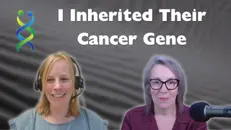
What happens when an inherited piece of genetic code predicts the exact cancers that took your family members — not as an active diagnosis, but as a ticking probability map?
In this episode of Changed By Cancer, Dr. Randi Paynter sits down with author Tiffany Graham Charkosky (Living Proof: How Love Defied Genetic Legacy). Tiffany has never had cancer, but her life has been shaped by it. After losing her mother at age 30, her grandfather in his 50s, and her uncle at 41, an astute researcher helped her family uncover an inherited gene mutation: Lynch syndrome.
Tiffany shares the raw, rarely discussed reality of cancer previvorship: managing genetic guilt, facing prophylactic surgeries to remove her uterus and ovaries at age 30 and 40, closing the door on family-building, and mastering the annual colon prep ritual as a self-described "colonoscopy doula".
In our signature Epi Edit breaks, Dr. Paynter unpacks why historical guidelines like the Amsterdam criteria routinely miss modern small families, the deep psychosocial gaps in hereditary cancer care, and the revolutionary new frontier of cancer immunoprevention vaccines like the Nous-209 platform.
Resources & Links Mentioned:
- Tiffany Graham Charkosky’s Memoir: Living Proof: How Love Defied Genetic Legacy tiffanygrahamcharkosky.com
- Lynch Syndrome Overview & Genetic Guidelines (NCBI): https://www.ncbi.nlm.nih.gov/books/NBK1211/
- DNA Mismatch Repair Biology (Peltomäki et al., Gastroenterology): https://pubmed.ncbi.nlm.nih.gov/36706841/
- Full transcripts, citations, and show archives: https://changedbycancer.com/
Disclaimer: Dr. Randi Paynter is a cancer epidemiologist, not a clinician. The discussions on this show explore lived experiences and healthcare systems and do not constitute medical advice. Please consult your medical team for personal health decisions.
Welcome to Changed By Cancer. I'm your host, Dr. Randi Paynter. In cancer epidemiology, we spend years studying the architecture of risk. We build predictive models, run survival regressions, and map out statistical probabilities across entire populations. But what happens when that abstract mathematical probability lands directly in your lap? Not as an active diagnosis, but as an inherited genetic blueprint that predicted the exact illnesses that killed your mother, your grandfather, and your uncle. Today's guest is Tiffany Graham Charkosky, author of the memoir Living Proof: How Love Defied Genetic Legacy. Tiffany has never had cancer, but her life has been fundamentally altered by it. She is what oncology calls a previvor—someone who carries a high-penetrance genetic mutation that dramatically elevates her lifetime risk of malignancy. Before we jump in, our usual reminder: I am a cancer epidemiologist, but I am not your clinician. The conversations we share here explore lived personal experiences and systemic healthcare issues. They are not medical advice. Please consult your own healthcare team for any medical decisions. Tiffany, welcome. When you were 11 years old, your family experienced a profound loss that seemed completely isolated at the time. Walk us through who in your family was touched by cancer and how that pattern slowly began to reveal itself.
TIFFANY:Sure. So when I was 11 years old, my mom died from colon cancer. And when I start the story that way, I feel like I actually have to say it well. And the year before, my grandfather died of cancer as well. And until I was almost 30, there didn't really seem like there was any connection to these two cancer deaths in my family, you know, losing my mother and my grandfather within a year of each other. Up until many years later when my uncle got colon cancer, he was in his early 40s. I was very new mother. I was in my late 20s. I had a baby, and my uncle got very sick. And I think at that time it started to feel like, "Oh, this is happening to my family again. We're kind of facing this again." And he struggled with colon cancer for about two years, and then a couple of weeks before we lost him, he underwent genetic testing. He was contacted by a research team from Case Western Reserve University in Cleveland, Ohio. He was being treated at University Hospitals here. And there was a geneticist, a genetics researcher who basically found him by looking through, you know, medical records at the university and the hospital she was affiliated with. And she was looking for families who she believed were slipping through the cracks when it came to who they might offer genetic testing to. So this was back in 2011. Genetic testing definitely existed at that time. People were getting the BRCA testing and so on. But there was—I don't think it was really out there in, like, the mainstream. These sort of hereditary cancers were not mainstream news. And her, the geneticist's belief at this time was that families that had or she believed should be tested for hereditary cancers were kind of not on the radar of doctors as people who they were offering testing to. And I don't know if you have ever talked about the Amsterdam criteria on your podcast, but the Amsterdam criteria is sort of like a checklist that medical professionals were using at the time, and I think they are still using in many areas. That's basically like how many relatives have had these types of cancers, how many first-degree relatives, and so on. And so my grandfather had passed away from cancer in his 50s. A year later, my mom passed away just shy of her 31st birthday. 15 years later, my uncle, in his early 40s, got diagnosed with cancer. We didn't meet the criteria for, like, the number of relatives who should be tested for this, but we also didn't have a huge family. So I think that, you know, having a smaller family, there weren't these numbers, these volumes of cousins kind of being diagnosed and so on. So we lost him in the spring, and that fall we received a letter from my aunt, which was basically sharing the geneticist's letter. It said Jeffrey had something called Lynch syndrome. It was—which is one of the hereditary cancer genes, and its more famous relatives are the BRCA1 and BRCA2 genes. And Lynch syndrome affects colon, gastrointestinal areas, as well as the uterus, ovaries, brain, skin, pancreas, et cetera. So she sent a message to all of us, all of us being my dad and to share with my brother and my sister and I, and then my grandmother, my remaining aunt and uncle on that side of the family. And I got this information, and all of a sudden it felt like my life, like, made sense. All of these losses, they weren't these random strikes of lightning. They were kind of an obvious, predictable outcome for a family that had been dealing with a lot of loss. And so we not only had been kind of dealing with, like, the actual loss of our families, but I think one of the things that really stands out to me is the way that a family is changed at, like, the foundation of a family is changed when they're losing people. When a family is losing a father, a brother, a sister, and it feels—it starts to feel like a personal thing. There's something wrong with me, something wrong with my family. So I ended up getting this information, and my aunt was very much like, "Do with this what you want. Like, I'm not trying to tell you what you should be doing." But she wanted us to know that my uncle had this testing. I don't have any cousins on that side of the family. It was just my siblings and I were the kind of only people left to consider pursuing this. And so the very next day, I wrote a letter to the geneticist. I said, "I feel like we need to meet." And she wrote me back instantly, like she wrote me back so fast that it scared me. Like, it was sort of like she'd been waiting for me. And it made me feel like, oh my gosh, I have information that's like very valuable to her, and that was a very strange feeling. But, you know, we emailed a little while, like a couple times, and I ended up going and doing a consultation with her and a genetics counselor to just learn, you know, what this all meant. I'd never heard of genetic testing. I had never heard of Lynch syndrome. I had never really thought about these things. And so, in the meantime, I'm a working mother. I have a young baby. Very quickly after I found out that Lynch syndrome was a thing that existed in my family, I also discovered I was pregnant with my second child. Which was, you know, a very, very much wanted pregnancy, and also one I was suddenly very scared to be carrying. You know, I was the exact age that my mother was when she died, when I learned that Lynch syndrome had impacted my family. And so I, you know, needed to get all my ducks in order. I'm an oldest daughter, like, type A, I like lists, I manage projects. I needed to kind of have my information and do what I was going to do. And a couple months later, I ended up actually getting the genetic testing and learned that I had, in fact, inherited the positive mutation for my MSH6 gene, which is one of the Lynch syndrome genes. And that really kind of set off like a whole domino effect of different, you know, more frequent screenings, conversations around prophylactic hysterectomy, and, you know, trying to decide at what time and what age my family-building part of my life would be done and my family-protecting part of my life would start. So this was, you know, all stuff I was just navigating, like, you know, a regular person, as we all are, when we discover something is wrong with our health. So, yeah. So I've been touched by cancer in the sense that I, you know, viscerally kind of feel the loss of losing my mother at such a young age, as well as the impact that put on me and the series of decisions that I had to make around my health over the next decade, which I'm still living in, actually. So.
RANDI:Let's pause for an Epi Edit. What Tiffany just laid out—the gap between an aggressive family pattern and clinical testing guidelines—is one of the most significant challenges in modern cancer genetics. Lynch syndrome, historically known as hereditary nonpolyposis colorectal cancer, is an autosomal dominant genetic condition. That means an individual only needs to inherit one mutated copy of a gene from one parent to carry the condition, giving every child that descends from that carrier a 50% chance of inheriting it. Lynch syndrome is caused by a germline mutation in one of several DNA mismatch repair genes. One of these genes is MSH6, and this is the one that Tiffany and several of her family members have a variant of. Inside every cell, DNA is constantly replicating. When errors happen, mismatch repair genes act as cellular spellcheckers, identifying misplaced bases and correcting them. When a DNA mismatch repair gene is mutated and defective, cellular typos slip through unchecked. This creates a state known as microsatellite instability, which accelerates mutations across tumor suppressor genes and causes lifetime risks of colorectal cancer as high as 70 to 80%, alongside elevated lifetime risks for endometrial, ovarian, gastric, biliary, and pancreatic malignancies. About 1 in 279 people in the general population carries a Lynch mutation, making it very common. Yet an estimated 90 to 95% of carriers have no idea they have it. The primary reason for this underdiagnosis is historical screening failure. For decades, clinicians relied on the Amsterdam criteria or Bethesda guidelines to determine who qualified for genetic testing. The classic Amsterdam II criteria required what was known as the 3-2-1 rule: at least three relatives with a Lynch-associated cancer spanning across two generations, with at least one being a first-degree relative and at least one diagnosis occurring before age 50. As Tiffany observed, the Amsterdam criteria have a massive blind spot: they require large pedigrees. In modern, smaller family structures with fewer siblings and cousins, a lethal dominant mutation can wipe out an entire lineage before the family tree is wide enough to satisfy the checklist. Because her mother died at 30 and her uncle at 41, the family didn't hit the strict numerical volume of cases until an observant academic researcher intervened. Without that researcher pulling records, Tiffany and her siblings likely would not have learned of their risk until one of them presented with an advanced symptomatic malignancy. You found out you carried this mutation right as you were pregnant with your second child and turning the exact age your mother was when she died. In Living Proof, you write about how understanding your genetics meant confronting the grief of losing her all over again. How did that shift how you remembered your mom?
TIFFANY:And so the real gift that working on this book gave for me was I spent hours and hours and hours and years and years of memories with my mom, and really had the opportunity to look at everything she had lost. All of a sudden, you know, because I was a mother, I could look at her with these empathetic eyes and see, oh, she wasn't just leaving. Like, I wasn't the only one losing someone in this story. I was able to see all of her fear, all of her strengths. I was able to really kind of think through the decisions I was making on behalf of my own family and see my mom had tried her best to do the same thing. And so what it really gave me was a sense that I got to know my mom in a different way, because I forced myself in the best way to really reexamine what our relationship might have been like had we gotten to grow up together. And the beauty was that I could look at her at the same age and feel like, what might I have been like as her friend? What kind of relationship might we have been able to have? So I didn't know how to tell the story of the genetic testing and the loss without also really looking at what I was so scared of. Like, why was this hitting me so hard? Like, I felt like the information was the worst news I'd ever been given. And I think there's a lot of people who do genetic testing and feel like, "Oh, this is such a gift. Now I can, you know, be empowered and make all these choices." And it really took me working through having lost my mom and learning what that meant for me. It took me working through all of those feelings to then be able to see my uncle did give me an amazing gift. It just took me a while to really believe that that's what it was. Part of the healing process, I think, is making sense of the process of what happened and how it impacted you and your own feelings, and how you're applying them to the version of the life that you have to live with the experience that you've just gone through. And so I feel like I want to tell everybody, like, if you're stuck in that space, like, try writing about it. The writing probably will scare you when you go back and read it. But I think for me, it was a real organizer for my feelings and my thoughts and helped me make sense of the way I was feeling and responding to everything in the wake of the information.
RANDI:Your brother and sister were navigating the same genetic fork in the road alongside you, but in very different bodies. How did you and your siblings approach your diagnosis, and what factored into your subsequent preventative choices?
TIFFANY:You know, my brother and I are both—we are the ones who tested positive for Lynch syndrome and our sister does not have it, thankfully for her. And I think that when you kind of carry something like Lynch syndrome, and I can only really speak for my brother and I, but we both, I think, just felt like I have to do everything I can to make this as least terrible as possible for the person who has chosen to spend their life with me. And so my brother, I write in the book, he also had Crohn's disease, has Crohn's disease, and it just wasn't able to be managed in a way that kept his risk for colon cancer also manageable. What we learned was that if you have Crohn's disease, most of the medications that you would take to kind of manage that increase your risk of colon cancer. So he was not able to be given these kinds of medications and he ultimately ended up doing a full colectomy. And part of the reason that he wanted to do that, and part of the reason that I had my preventative surgeries—I've had a hysterectomy, I've had an oophorectomy, which is ovarian removal, and I hope I said that right—I think that it can feel very out of control knowing that you're living with this risk. And I think it can feel like I don't know if I can trust these body systems that are supposed to be keeping me healthy to do that. And so part of the preventative surgeries is that you're also in control of when these things are happening, when you're having the surgeries, and you're able to deal with them in a preventative way instead of in a way that is something has gone too far. And so I think for both my brother and I, it was this feeling of needing to do as much as we could do so that our spouses wouldn't feel like they were constantly dealing with something being wrong with us. And I think that's sort of like one of those weird invisible pressures that you put on yourself. Like they don't tell you when you get genetic testing that like maybe you'll start feeling these different kinds of feelings. And I think that ultimately I'm happy that I've had the option to get my surgeries. I like it way better than the alternative. I'm also still not, like, happy I had the surgeries. I'm still not like—so I think there's, you know, learning to live with things and making the best decisions that you can for yourself and for your life. And the other thing that my brother and I really have going for both of us is that we are, like, really good natured people. We are both, like, optimistic people. We get along with people, we're not, like, prone to depression, which I'm so grateful for. So I do feel like our kind of emotional and, like, mental makeups, like, helped us sort of move through this in different ways, that fully acknowledging that, like, not everybody who has this happen, you know, is like born as like a half-glass, half-full person, which I think we both were. And, you know, my kids spend all kinds of time with my brother, Uncle Danny, and he's like just the coolest guy. He's, like, funny. He loves to golf. He taught himself how to play guitar in his 30s, and he's just, like, a fun, like, easygoing guy. Like, my kids needed to be picked up from daycare for some reason and I couldn't get there, like, he's the person I would call, and he would get there. So, like, he's that kind of guy. And so I feel like very, very, very lucky to have him in that relationship.
RANDI:When you received your test results, the emotional fallout was immediate. You were paired with a genetic counselor named Lou, but that relationship quickly evolved beyond just reviewing probability charts. How did he support you through that initial storm?
TIFFANY:So my experience was that the genetic counselor, the geneticist met with me at the same time. And then I took the news very badly. And I think that when I first met them, the genetic counselor, Lou, in the book, I think he felt bad for me because this information had been, like, brought to me. And he ended up seeing me, like in a therapeutic way once a week from the time we met first until—we met for the first time in November, I had my blood drawn in February—so we met once a week for about 12 weeks, in which I was just, you know, sort of doing all the things that you would do if you were seeing a therapist or a counselor. And my insurance was never charged. I was part of a clinical trial or clinical study, you know, that was like they reached out to me. They covered all the expenses of the testing and I realized in retrospect that he was just seeing me like, I think he felt like we opened this can of worms on this poor woman, and she doesn't know where else to go or what else to do. And I had like the most amazing experience where I reached out to him when the book was published and I wrote him a message and I said, "I don't know if you remember me, but I wrote this book and I would love to send you a copy." And he wrote back to me and he said, "I'm so surprised you remember me." He left genetic counseling to become a psychotherapist, and he said that he'd seen enough patients like me who he felt like genetic counseling wasn't giving them the support that they needed, that we were getting the medical support. We were being told, "Here are your risks, and here's what your surgical options look like." And the genetic counseling side of it is so much about risk management. It's a numbers game. It's: how are you—if you have this, then here is your plan of action. And he ended up changing professions and became a psychotherapist, just because he felt like—and he specializes in people with genetic conditions, but he also sees all kinds of other people, a lot of people with medical problems—just became a therapist, basically. And so I felt like I felt very well supported by him. And I think that what I really needed at that time was a space to dump everything I was feeling on someone who I wasn't married to, and someone who I wasn't related to. I felt like I couldn't bring the psychological stuff I was going through into my home and still be a parent and still be a worker and still be a wife. It felt like I needed this separate place to go and sort of dump all this stuff out and then collect the pieces of it that I could apply in my actual life. I felt a lot of shame. If I were going to pick one emotion that I had, the strongest emotion I had at that time was, it was shame. And that I was going to break my family. I was going to repeat the cycle that I had been born into, and it was going to happen all over again. But in this instance, I would be the mom instead of the child, and I was just leaving my husband and leaving my kids. And, you know, that was the story that I was writing in my own brain. And it really, that was not a healthy place for me to be living in. And so I'm so grateful that I had the chance for my genetic counselor to really do a lot more with me than he probably was expecting to. And I think it's something that a lot of people going through genetic testing maybe need, but there isn't like an obvious pathway to that social-emotional support as part of, like, the treatment plan. Like, I wasn't ever recommended to see a psychologist for this until I was like 42, when, like, we're talking like 10 or 12 years had gone by. And I was talking to my doctor, just sort of like my gastroenterologist. And I was like, "You know, at some point we need to make a plan for screening my pancreas, and like at what point does that happen and what does that look like?" And she started asking a couple more questions, and then she was like, "Do you live with this feeling all the time?" And I was like, "Yeah." And that's when she made, like, a recommendation for me to talk to a psychologist through the clinic that I'm seen at, who I saw, you know, once or twice. We did not have, like, a very long relationship. She was lovely. She gave me what I needed at the time I needed it, and I could go back if I need it now. But it's just a weird thing that it was this sort of revelation that, like, "Oh, maybe this would be helpful for you." So yeah.
RANDI:Let's pause here for an Epi Edit. Tiffany just described an experience that public health researchers and psychiatric oncologists refer to as the psychological cost of previvorship or illness in absentia. When someone undergoes genetic testing and tests positive for a pathogenic cancer variant, they cross an invisible medical threshold. Mechanically, they are entirely healthy; they do not have cancer. But psychologically and clinically, they are suddenly assigned the intense surveillance schedules, prophylactic organ resections, and scan-associated terror of a chronic cancer patient. Epidemiologic studies evaluating carriers of hereditary cancer mutations show clinically elevated rates of anxiety, distress, and intrusive health worries that persist for years after disclosure. Yet within standard delivery models, genetic counseling is almost entirely front-loaded around risk estimation, pedigree charting, and surgical education. Once testing confirms a mutation, patients are handed surgical referrals and high-risk screening protocols, but standard clinical pathways almost entirely lack structured, long-term psychological support. This absence of psychological care is further compounded by genetic guilt. Carriers frequently experience complex familial guilt, grieving that they carry the same biological flaw that killed their parents, struggling with the survivor guilt of testing positive while a sibling tests negative, and bearing the emotional weight of potentially passing that variant down to their own children. It is telling that Tiffany's genetic counselor, Lou, recognized this profound gap and chose to provide 12 weeks of unbilled counseling to help her process that trauma, an experience that led him to leave laboratory genetics entirely to practice psychotherapy. His career transition is a direct commentary on the limitations of modern genetics. We have built extraordinary diagnostic tools to identify genetic risk, but we have failed to build the mental health infrastructure required to help patients live with that knowledge. Because Lynch syndrome carries a high lifetime risk of gynecologic malignancies, women are faced with irreversible surgical decisions. At age 30, you had a prophylactic hysterectomy, followed later by an oophorectomy. What was it like having to close the door on family-building so early?
TIFFANY:Yeah. So one of the things that my geneticist talked to my husband and I about when we learned that I had tested positive for Lynch syndrome was she talked about how there are people who choose to do in vitro fertilization if they want to create an embryo that does not carry the mutation. She said that was an option that we could pursue. And my husband and I, we felt like we, one, did not have, like, the financial resources to pursue IVF. We did, or I guess wouldn't make the choices to figure out how to finance it or what have you. So IVF was an option that we, you know, could have explored. And I think that I had this very strong feeling that I had, as far as I knew, a healthy baby, brand new healthy baby and a healthy toddler. And this feeling that I didn't want to spend their whole childhoods kind of trying to have another baby, trying to kind of go through what it would have taken to do that or just, you know, get pregnant again and hope for the best. It felt like having the information meant I had to make some different decisions. I had to act like a parent in a way that I hadn't ever had to before, and really felt like it was my job and my duty to figure out how I could be there for the kids that I already had as best as I could. And simultaneously, like, I didn't want to give this imaginary conceived, medically supported embryo a better outcome on life than I had for my already existing children. And I also just want to note that, you know, they're not testing for all kinds of other things that could happen. And I thought, well, what if you had a baby that didn't have this one thing, but then, you know, something else was wrong? It just felt for me like it wasn't the path for me. At the same time, I come from a family of three. I'm very close to both of my siblings. I don't have a daughter. I'm so close to my sister, I love my brother so much, I'm also so close to my sister. Just this feeling that, you know, I would definitely, definitely never have that relationship in my own life was, you know, a choice. And I know that having a third child would not, you know, guarantee a daughter either. It all felt to me like it was sort of turning away from what I had in an effort to focus on what I did not have. And so I had my second son when I was 30 and, about three months after he was born, I had my hysterectomy. So that was it, it was just—that was it. And one of the things that I didn't know until I was planning for the hysterectomy was that I thought I would have to stop breastfeeding, you know, if I had a hysterectomy. But in fact, I learned that two completely different pieces of your body, like totally separate, you know, hormonal things. And so I felt like the mental excuses I was making for myself, like, "Oh, well, I'll have it when I'm done breastfeeding if it means I can't do it," like those roadblocks were sort of getting removed, and then my uterus started to feel like just a ticking time bomb. It just felt like, if I'm not going to have any more babies, what am I doing waiting to have the surgery? So that was the point at which we made it. I think that, for me, like I said earlier, that, you know, I'm a pretty optimistic person and I think I'm able to mostly do a good job of not second-guessing choices that I've already made. But that doesn't mean that, like, every once in a while it isn't just like a little bit of a sting. But I don't know that we would have really had another child. Like, it's just when that option is taken away and you can't, I think that's like the piece that you kind of ruminate on. It's always like the option no longer available becomes the thing that you, you know, think about. So.
RANDI:Outside of the major surgeries, living as a Lynch previvor means adhering to intense, lifelong diagnostic surveillance, specifically annual colonoscopies. And you have turned bowel prep into an art form.
TIFFANY:If you ever need a recommendation, I can help you! Well, you're supposed to stop eating things like nuts and raw vegetables and things like that like two days before your colonoscopy. I always stop eating them like 3 or 4 days before because I really like getting, like, an excellent mark on my sheet that says, like, you were very clean. So I stop eating like any sort of, like, high-fiber food like about four days beforehand. And then I make a lot of Jell-O, and I buy a lot of, like, I buy myself really nice clear drinks. So I buy, like, coconut water and all this fancy sparkly waters that I might ordinarily think are, like, too expensive for me, and lemonade powder mix for when things taste too gross. And I just—I feel like I sort of have just created this, like, sit down in the morning and eat a piece of Jell-O and drink your black coffee and make it feel like a meal, and like, same thing with, like, my miso soup broth and my ginger ale like at lunch. And so it's just, like, trick yourself into thinking that it's a food, like eat something salty like a soup instead of just like Gatorade, because your brain thinks it's more of a meal. I'm very, very ritualistic about it. I have to kind of do everything in the same way every time. And always take all of your prep and always drink a lot more than you think you need to. So those are my—oh, and use Aquaphor when you go to the bathroom! My friend calls me her colonoscopy doula.
RANDI:Let's bring in one more Epi Edit. Tiffany's annual colonoscopies and her preventative hysterectomy and oophorectomy have historically been the foundational pillars of Lynch syndrome management. In gynecologic oncology, prophylactic total hysterectomy and bilateral salpingo-oophorectomy after childbearing is remarkably effective, reducing the risk of endometrial cancer by roughly 90 to 100% and significantly mitigating ovarian cancer risk. Similarly, high-quality annual colonoscopies with meticulous bowel prep are proven to reduce colorectal cancer incidence by over 60% and lower mortality by more than 70% in Lynch carriers. This is because colon tumors in Lynch syndrome develop along a distinct hyper-accelerated adenoma-to-carcinoma sequence. While a sporadic polyp in the general population takes 10 to 15 years to turn into an invasive adenocarcinoma, a mismatch repair-deficient polyp can progress into an invasive tumor in as little as 1 to 3 years. That aggressive kinetic window is precisely why standard population guidelines, which recommend colonoscopies every ten years starting at age 45, are deadly for Lynch carriers, which require screening every 1 to 2 years starting in their early 20s. Yet as effective as surveillance and surgical resections are, they represent crude, reactive measures. We are either monitoring for tumors or removing healthy organs to avoid them. Today, oncology is entering a revolutionary new frontier: immunoprevention. Because mismatch repair-deficient cells cannot fix replication errors, they routinely generate distinct mutated frame-shifted proteins called neoantigens. These neoantigens do not exist in normal, healthy tissue. Researchers have recognized that because Lynch tumors across different patients share a predictable profile of these frameshift peptides, it is possible to build an off-the-shelf cancer preventative vaccine. Vaccine candidates currently in clinical trials train the carrier's immune system to recognize these shared neoantigens. If a micro-colony of mismatch-deficient cells begins forming anywhere in the body, vaccine-primed T cells can hunt down and destroy those pre-malignant cells before they ever aggregate into an invasive carcinoma. It is the biological realization of moving oncology from early detection to true interception. You're actively participating in a clinical trial testing a cancer-preventative vaccine for Lynch carriers. As you watch that science evolve, how do you talk to your teenage sons about what their own future might look like?
TIFFANY:The recommendation that I've been told by multiple people on my care team is to wait until they're 18 or even a little bit older so that they are kind of emotionally capable of, like, making informed decisions about their behaviors and, like, their levels of risks and so on. So I feel like this—they have not been tested at this point. I hope that they will be tested when they are ready and that I can support them through it. And I also try to tell myself that they're not carrying the same kind of baggage around Lynch syndrome that I was because I've been here with them this whole time. It's not like, "Oh, well, I've inherited this thing that killed my mom." So I'm hoping that it can be something that I'm living by example of how to live with uncertainty and risk and make the best choices that I can from a medical perspective. Hoping to, you know, show them that it doesn't have to be, like, a death sentence or something like that, which is the way I interpreted it when I first learned it. I'm hoping that it's just as something that needs to be managed, like any other health condition that they may or may not have to deal with as they get older. But I'm hopeful that should one or both of them have Lynch syndrome, that it doesn't feel like this sort of the world is ending, but instead there's a roadmap for ways that they can, ways that they can do their best to help prevent it. Yeah. I mean, I was—because of them, I was in a clinical trial last year. I'm actually still technically in the clinical trial for an immunotherapy treatment as a vaccination against cancer for people with Lynch syndrome. And my gastroenterologist recruited me for it. And it's so funny, though, because you have to do blood work, you know, to make sure that you are healthy enough to take it, but also to make sure that you are a carrier for Lynch syndrome. And there was this weird part of me that was like, maybe they'll tell me I don't really have it. Like, maybe it was a mistake! And then it was like, okay, well, you qualify for the trial. And there was a part of me that was like, oh man! So, no, I mean, it was a series of shots spread out over several months. Immunotherapy mixed with some agents that are found in cancer to sort of activate, like, a strong immune response to it. And as far as I know, I'm in phase IIb of the clinical trial. There's a similar trial that's been getting a lot of attention in the news, the Nous-209 immunotherapy, and that has a larger number of things that it's vaccinating against. And it was in phase one and it got fast-tracked to go to the next phase. So I also feel like it's very scary, and it's also a hopeful time for this kind of genetic information. It shows kind of what prevention might look like and how much more important it is for people who might not even know that this exists in their families, like we were talking about earlier, to have access to this kind of testing and information. And if it could be, you know, something like a series of shots is shown to have the same success rate as other forms of treatment, it's very different. The other thing is with having boys is they don't have to look at prophylactic surgeries. They're looking at colonoscopies and screenings. And it's just this weird thing where with, you know, both Lynch and the BRCA mutations, and some other hereditary cancer mutations as well, the reproductive system in women is really part of all of it, which is not the same in the way that it impacts men. And it's just like another sort of hurdle, mental, emotional, physical, that women are sort of going through when it comes to facing this kind of information in a proactive way. I'm just grateful that, like, the conversation around being able to prevent these kinds of diseases is happening because it means good things for so many people. And I think it also, you know, you hate to look at, like, the hierarchies of, like, who deserves to have the feelings that they're having or who deserves support and who doesn't. And it's good to feel like there's a space for all of us and we all have different needs at different times. And so many people get cancer, like, what is it, 1 in 2, 1 in 3? Whether you're personally sick or you've watched somebody you love dearly face cancer, it really changes the way that you see the world to go through that. And so I'm grateful to get to share my story and make it seem a little bit less lonely.
RANDI:When society talks about cancer, we celebrate the bell-ringers, the survivors who make it through the grueling trenches of chemotherapy, radiation, and active disease. But Tiffany Graham Charkosky reminds us that survivorship begins long before a cell even turns malignant. Previvorship is its own profound act of endurance. It means living in the tension between health and heredity. It means volunteering for the operating room while still entirely well, submitting your body to clinical trials to protect the next generation, and waking up every day refusing to let an inherited piece of code define your family's story. Tiffany, thank you for your candor, your incredible humor, and your fierce commitment to rewriting this legacy. You can find links to Tiffany's book, which is called Living Proof: How Love Defied Genetic Legacy, as well as clinical sources on Lynch syndrome and mismatch repair biology, in the show notes at ChangedByCancer.com. If this episode gave you insight into the hidden world of cancer prevention, please subscribe, leave a review on the platform of your choice, and most importantly, share this story with someone who needs it or would even just find it interesting. I'll catch you on the next episode.
